
Name the thing you are maximising
Management games punish vagueness. Before the first build, decide: profit, aesthetics, efficiency, or story. Stardew Valley played for profit looks nothing like Stardew Valley played for completion, and mixing the two is how players burn out in year two.
Build the backbone before the decoration
In Factorio and Satisfactory, build the smelting and power backbone first and expand it in straight lines, leaving room. In Cities: Skylines II, lay the road hierarchy and utilities before zoning. Retrofitting a backbone is the single largest source of wasted time in the genre.
Leave space you think you will not need
Every one of these games expands faster than new players expect. A belt line that is "plenty" at hour two is a bottleneck at hour ten. Double the space you think you need between production blocks — it costs nothing now and saves a rebuild later.
Automate the boring thing first
Pick the one action you repeat most and automate that, not the most complex one. In Stardew Valley that is usually watering, then harvesting. In Factorio it is plate production. Automation compounds: each one removes a chore and frees attention for the next.
Use the game clock honestly
Daily and seasonal cycles create real trade-offs. Check what the store page lists for playtime expectations and set sessions accordingly — a day in Stardew Valley is short, a Factorio build is not. Ending a session at a clean boundary beats stopping mid-chain.
Save before experiments
Most entries here allow manual saves or have an autosave you can roll back. Before a large rebuild or an unusual policy change, make a separate save. Experimenting is the point of the genre; losing an evening is not.
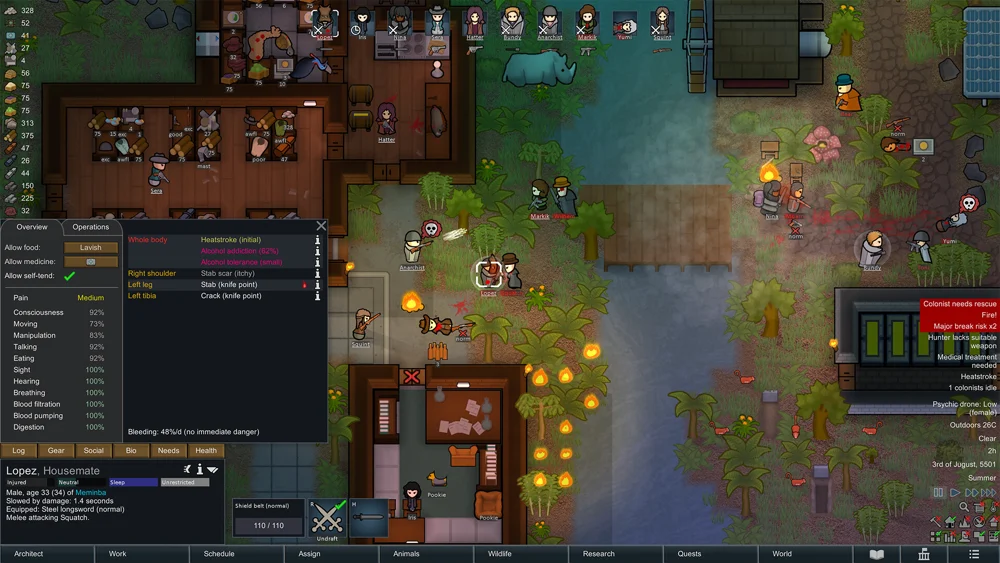
RimWorld: difficulty is a story setting
The storyteller setting decides whether you get a colony or a narrative. Choose the one you actually want — Cassandra for a steady curve, Phoebe for quiet stretches, Randy for chaos — and adjust it mid-campaign rather than restarting.
Cities: Skylines II: fix traffic before zoning more
Traffic grids fail at junctions, not at capacity. Watch where vehicles bunch, and fix that intersection or add a second route before you zone the next district. Adding demand to a broken network makes it worse everywhere.